Athens is stepping up its response to the latest developments in the Aegean and Eastern Mediterranean, moving simultaneously on two fronts: accelerating plans to restart work on the Greece–Cyprus electricity interconnection and preparing diplomatic action over Turkey’s latest moves in the region.
The Greek government says it intends to proceed on the basis of international law, while making clear that attempts to create faits accomplis affecting Greece’s sovereign rights will not go unanswered.
At the same time, opposition parties are pressing the government to adopt a tougher stance toward Ankara and bring the issue more forcefully before European institutions.
Greece–Cyprus Power Link Moves Back Into Focus
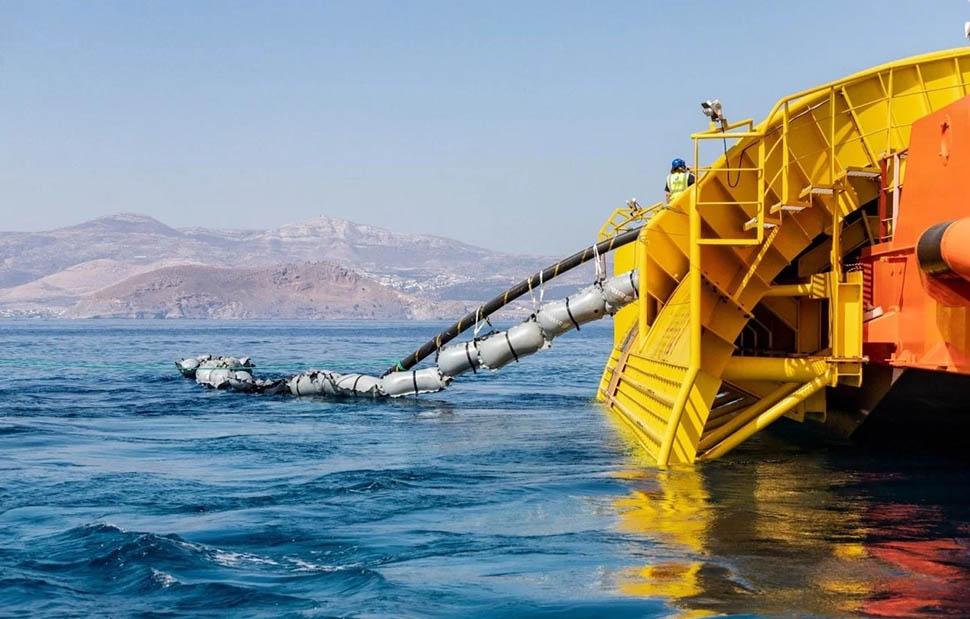
The immediate priority for Athens is to restart seabed surveys for the Great Sea Interconnector, the ambitious electricity cable designed to link Greece and Cyprus.
Momentum behind the project has increased since the August 5 agreement with French infrastructure investor Meridiam, which brought a stronger French presence into one of Europe’s most strategically important energy projects.
The next stage requires specialized survey vessels to return to the waters between Greece and Cyprus to determine the optimal route for laying the subsea cable.
For that to happen, a new NAVTEX will be required.
Environment and Energy Minister Stavros Papastavrou said the necessary procedures are already underway, although he avoided setting a specific date for the resumption of the surveys.
“The necessary steps are already being taken for the project to enter this phase,” Papastavrou told ERTnews, adding that he did not want to give dates “for communication purposes.”
Athens: The Project Will Move Forward Under International Law
Papastavrou stressed that Greece intends to proceed with the interconnection in accordance with international law.
The project, involving Greece’s Independent Power Transmission Operator ADMIE and Meridiam, is one of the European Union’s major Projects of Common Interest and is intended to end Cyprus’ energy isolation by connecting the island to the continental European electricity grid.
Cyprus also sees the latest developments as a turning point.
Cypriot government spokesman Konstantinos Letymbiotis said the project is now “closer than ever” to implementation, highlighting the importance of France’s involvement.
“This is not a project concerning only Greece, Cyprus and France,” he said. “It is a Project of Common Interest which has received the highest level of funding. France’s participation strengthens our diplomatic leverage.”
New Tensions Over Turkey’s Maritime Parks
The second front concerns Ankara’s declaration on August 15 of Turkish marine parks in the northern Aegean and Eastern Mediterranean.
Athens views the move as another expression of Turkish revisionism and says it will not allow it to pass without a response.
Deputy Foreign Minister Tasos Chatzivasileiou described Turkey’s move as illegal and argued that it produces no legal effect.
“In the coming period, the Foreign Ministry will take action to make clear internationally what is happening,” he said.
According to Chatzivasileiou, Turkey is attempting to respond through unlawful measures to initiatives Greece has undertaken legally.
“Nothing will remain unanswered,” he added.
Government Links Turkish Reaction to Greece’s Regional Strategy
New Democracy spokeswoman Alexandra Sdoukou linked Ankara’s reaction to the broader strategy pursued by the Mitsotakis government in both maritime policy and energy.
She pointed to Greece’s own marine parks and recent energy agreements as examples of initiatives that have changed the regional landscape and, in her view, triggered Turkey’s response.
Athens’ message is that these policies will continue despite Ankara’s objections.
Opposition Calls for a Stronger Response
The government is also facing pressure at home.
PASOK-KINAL parliamentary spokesman Dimitris Mantzos described Turkey’s marine park declaration as provocative and called on Athens to raise Turkish actions more forcefully at the European level.
He argued that the latest developments undermine the idea of “calm waters” in Greek-Turkish relations.
SYRIZA has also called for a stronger European response, while the Communist Party (KKE) questioned whether the European Union and NATO can effectively safeguard Greece’s sovereign rights. Other opposition parties have also criticized the government’s handling of relations with Ankara.
A Delicate Test for Greek-Turkish Relations
The latest developments come at a sensitive moment for relations between Athens and Ankara.
Greece continues to support dialogue with Turkey, but its position is that dialogue cannot come at the expense of sovereign rights or international law.
The coming weeks could therefore prove crucial.
Restarting the seabed surveys for the Greece–Cyprus cable would move a strategically important European energy project forward. At the same time, Athens’ response to Turkey’s maritime initiatives will test whether the recent period of relative calm in Greek-Turkish relations can be maintained.
For the Greek government, the message is clear: dialogue remains open, but attempts to create faits accomplis will be challenged.
Greek Finance Ministry: Lower Debt Means Greater Benefits for Citizens
Greece Introduces New Spatial Planning Framework for Renewable Energy Projects
Ακολουθήστε το Lykavitos.gr στο Google News
και μάθετε πρώτοι όλες τις ειδήσεις