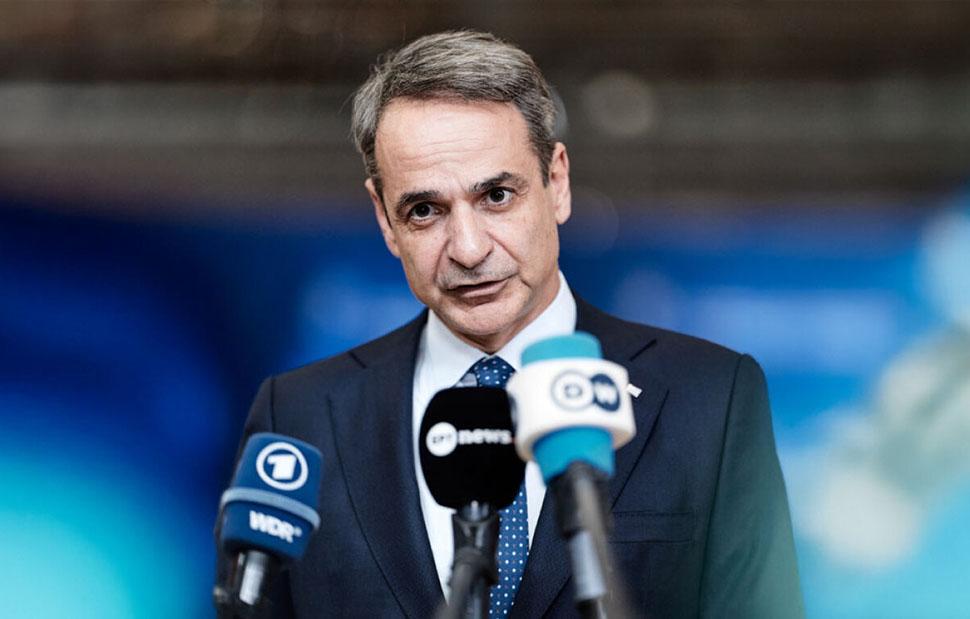
Early this morning, due to a packed agenda and a series of complex issues, the European Union Summit kicked off in Brussels, running through tomorrow, Friday. On the table is the Greek and Italian push for fiscal flexibility, aimed at allowing Europe to collectively address the high energy costs weighing on households and businesses. Kyriakos Mitsotakis has repeatedly argued to his fellow EU-27 leaders in recent weeks that Europe must rise to the current moment and find ways to support citizens and businesses in the face of soaring energy prices that are fueling inflationary pressures — all while maintaining fiscal stability and sustainability.
According to his aides, the Prime Minister is also expected to reiterate the importance of completing the European Energy Market and strengthening energy interconnections. He will stress, however, that more medium-term measures are needed to address the current difficult environment. He will also underline that the green transition is a long-term goal, and that Europe must right now revisit its approach to energy security and adapt its policy accordingly.
As outlined in today’s European Council agenda, “on energy prices, EU leaders will provide guidance to the Commission on targeted and temporary short-term measures to ease the impact of high energy prices, protecting EU citizens and businesses. They will also discuss Europe’s long-term strategy to reduce its dependence on fossil fuels.”
Mitsotakis: “We must prove as Europe that we can support our citizens when they need it most”
Kyriakos Mitsotakis has already sent a letter to Ursula von der Leyen, requesting that options be explored to grant member states additional emergency fiscal flexibility amid the current crisis, particularly regarding fuel prices. “You know very well that the European fiscal rules framework sets specific spending ceilings that we cannot exceed, even when we have additional resources available to deploy,” the Prime Minister said yesterday at the inauguration of the autonomous energy storage unit belonging to Metlen Energy & Metals and the Karatzis Group in Nees Karyes, Larissa. He emphasized: “We must prove — not just as Greece, but as Europe — that we can tackle not only long-term challenges like the green transition and ambitious climate neutrality targets, but ultimately support European citizens when they need it most.”
In the same speech, he revealed that beyond the fiscal flexibility issue, he will raise two additional topics at the Summit: support for European — and by extension Greek — industry, calling on the EU “to make reindustrialization its top political priority”; and the issue of shipping, which cannot cope with the “very rapid decarbonization process” without at least passing the costs on to the end consumer.
The EU Summit agenda
The key issues on today’s and tomorrow’s agenda for the leaders of the EU’s 27 member states are as follows:
EU long-term budget: The budget for the 2028–2034 period — expected to reach as much as €2 trillion in total — remains unresolved, with significant disagreements between member states. Greece’s position is that an ambitious European budget is needed, one that addresses new priorities such as defense, security, research, and innovation — but these new priorities cannot be funded at the expense of Cohesion Policy and the Common Agricultural Policy (CAP). Greece will not accept further cuts in these areas, but remains open to discussions on a new own-resources package — having already submitted relevant proposals — provided the cost-sharing does not disproportionately burden less developed economies.
Ukraine: Leaders will discuss the continuation of support for Ukraine, including the operational needs of its critical infrastructure ahead of winter.
European security and defense: On the table is Russia’s increasingly aggressive behavior, including its hybrid attacks across Europe. Discussions will cover EU defense readiness and how to maintain momentum and accelerate work on addressing critical gaps in military capabilities. According to Politico, European leaders are preparing to push for tougher sanctions against Russia, putting them on a collision course with Donald Trump — just days after the US President reached a deal with Vladimir Putin to ease restrictions on Russian diesel oil exports.
Migration: In a letter to the EU-27, European Commission President Ursula von der Leyen called on leaders to discuss measures such as establishing an emergency response framework for cases of migration instrumentalization, expanding Frontex’s mandate, and increasing the rate of deportations from the European Union. Greece, as government sources emphasize, was among the first member states to highlight the importance of protecting the EU’s external borders, and has expressed satisfaction with the Commission’s support for its proposal on a European emergency mechanism to handle mass influx or the instrumentalization of migration pressure — as in the case of the Evros river border in 2020.
EU enlargement: The Greek government is expected to reaffirm that “we assess each country based on its own performance, and our priority is that every country fully meets the commitments it has undertaken,” while also reminding partners that “enlargement decisions retain their unanimity requirement.” This means that Europe’s path to, for example, Tirana or Skopje runs through Athens as well.
Middle East: The Summit will also address the latest developments in the Middle East, including freedom of navigation and maritime security — both critical to global supply chains, and particularly to energy, fertilizers, and food.
TIF 2026: Thessaloniki Becomes the Launchpad for Greece’s Election Battle
JPMorgan Warns of New Food Price Surge in 2027 as Global Risks Mount
Ακολουθήστε το Lykavitos.gr στο Google News
και μάθετε πρώτοι όλες τις ειδήσεις