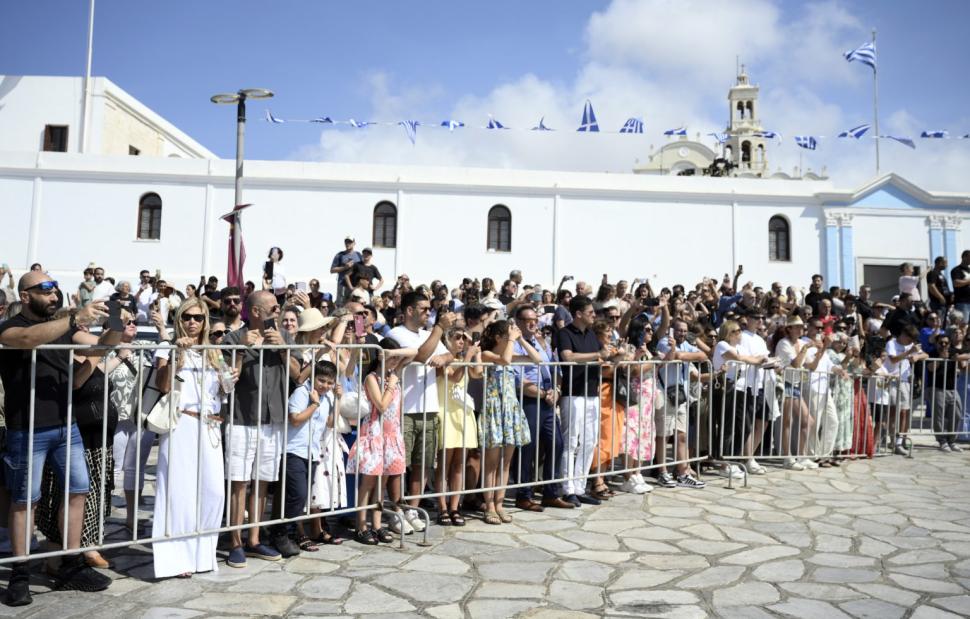
Every August, Tinos becomes the spiritual heart of Greece.
Thousands of people arrive from across the country and abroad to worship at the Church of Panagia Evangelistria, light a candle, fulfill a sacred vow or simply spend a few moments in a place that, for more than two centuries, has been closely associated with faith, hope and human struggle.
For the people of Tinos, the Dormition of the Virgin Mary on August 15 is more than the island’s biggest religious celebration. As Tinos Mayor Panagiotis Krontiras puts it, it is the “Easter of the summer” — a day of both honor and blessing for the island.
And every year, Tinos is transformed.
The already busy August tourist season meets a huge wave of pilgrims, pushing the island’s infrastructure to its limits.
“We are already at our limits,” Krontiras says, noting that in August — and particularly around the Feast of the Virgin Mary — the island’s population quadruples.
Saint Pelagia and the Discovery of the Icon
The story behind Greece’s most famous Marian pilgrimage goes back to the early years of the Greek War of Independence.
According to the Panhellenic Holy Foundation of Evangelistria of Tinos, Pelagia, a nun at the Monastery of Kechrovouni, repeatedly saw the Virgin Mary in visions. She was shown the place where a sacred icon was believed to be buried and was instructed to begin a search.
The first excavations took place in 1822, with efforts intensifying early the following year.
On January 30, 1823, the icon of the Annunciation of the Virgin Mary was discovered — a date that has held special significance for Tinos ever since.
News of the discovery quickly spread across revolutionary Greece.
At a time when the outcome of the struggle for independence remained uncertain, many Greeks interpreted the finding of the icon as a divine sign that their fight for freedom would ultimately succeed.
Some of the most important figures of the Greek Revolution traveled to Tinos to pay their respects, among them Theodoros Kolokotronis, Andreas Miaoulis, Nikitaras and Yannis Makriyannis.
From its earliest years, the icon of the Virgin Mary of Tinos became linked not only with Orthodox faith, but also with the modern history of Greece.
A Church Built With the Help of the Faithful
The imposing Church of Evangelistria was built on the site where the icon was found.
Its construction required substantial resources, materials and labor, with donations from ordinary believers playing a crucial role.
Over time, the church and the Panhellenic Holy Foundation of Evangelistria became important not only to the religious life of Greece, but also to the social and cultural history of Tinos.
The Foundation developed extensive charitable and educational activities, supporting schools, scholarships and cultural initiatives.
Yet what ultimately made Tinos a place of such profound importance to millions of Greeks is something far more personal: the relationship between believers and the Virgin Mary, known here as the Megalochari — “She of Great Grace.”
The Road to Panagia and the Sacred Vows
One of the most powerful images associated with Tinos is that of pilgrims making their way on their knees from the port to the church.
For those who undertake the difficult climb, it is an intensely personal act.
Some made a vow while facing illness or another difficult moment in their lives. Others return to give thanks for a prayer they believe was answered. For some families, the pilgrimage is a tradition handed down from one generation to the next.
Around them are people of all ages carrying candles and offerings.
Small metal plaques, jewelry, religious icons and deeply personal objects become tangible expressions of a prayer, a fear, a hope or simply a “thank you.”
The scene has been repeated for generations. But for the people making the journey, there is nothing routine about it.
Behind every offering is a story.
The Celebrations Begin on August 13
The events leading up to August 15 traditionally begin two days earlier.
On August 13, an open-air service is held in the courtyard of the church. The sacred icon is brought outside, allowing the faithful to gather around it and take part in prayer.
On the eve of August 15, wreaths are laid at the memorial to the Greek cruiser Elli, followed by the solemn Great Vespers service.
Then comes the morning of August 15.
The day begins with the Divine Liturgy and reaches its emotional peak with the procession of the icon through the streets of Tinos town.
As the icon leaves the church, thousands of people fill the main avenue.
Church bells, Orthodox hymns and crowds of pilgrims create one of the most recognizable scenes of the Greek summer.
The Elli and the Other Memory of August 15
Yet August 15 carries another, much darker meaning on Tinos.
On August 15, 1940, the Greek light cruiser Elli was anchored outside the port as part of the celebrations honoring the Virgin Mary.
It was torpedoed and sunk by an Italian submarine.
The attack came just months before Greece entered World War II and became one of the defining events in the island’s modern history.
For Tinos, the memory of the Elli has been inseparable from August 15 ever since.
Following the religious ceremonies, a government representative and local authorities traditionally board a Hellenic Navy or Coast Guard vessel and sail to the spot where the Elli lies beneath the sea to pay tribute to those who died.
Within the space of just a few hours, Tinos experiences two deeply rooted ceremonies: one centered on faith and the procession of the Virgin Mary, the other on remembrance and a defining moment in modern Greek history.
Traditions That Have Survived
Despite the profound changes that tourism and modern life have brought to Greece’s islands, Krontiras says the traditions surrounding August 15 on Tinos have endured.
The open-air prayers, Vespers, Divine Liturgy, procession of the icon and ceremonies honoring the Elli continue to be observed and passed down from one generation to the next.
And Tinos’ relationship with the Virgin Mary is by no means limited to August.
The island also commemorates the discovery of the icon on January 30, the Annunciation on March 25, and Saint Pelagia’s vision on July 23.
Still, August 15 remains the moment when everything comes together.
The island fills with people. The streets become packed. The religious pilgrimage meets the height of the summer tourist season.
But behind the crowds are thousands of individual stories.
A prayer for someone going through a difficult time.
A promise that has finally been fulfilled.
A family returning to the island, as it does every year.
An elderly pilgrim following the same road he or she first walked as a child.
More than two centuries after its discovery, the icon of the Virgin Mary of Tinos remains at the center of a relationship that, for many of those who make the journey, needs little explanation.
And on August 15, when the icon once again passes through the streets and, a short while later, the island turns toward the sea to honor the Elli, Tinos will experience once more what its mayor calls the “Easter of the summer” — a day when personal faith meets Greece’s collective memory.
Papathanasis: TIF Economic Package to Exceed €1 Billion, With Middle Class, Pensioners and Young People in Focus
PPC Earns ISS STOXX “Prime” Status Following New ESG Rating Upgrade
Ακολουθήστε το Lykavitos.gr στο Google News
και μάθετε πρώτοι όλες τις ειδήσεις